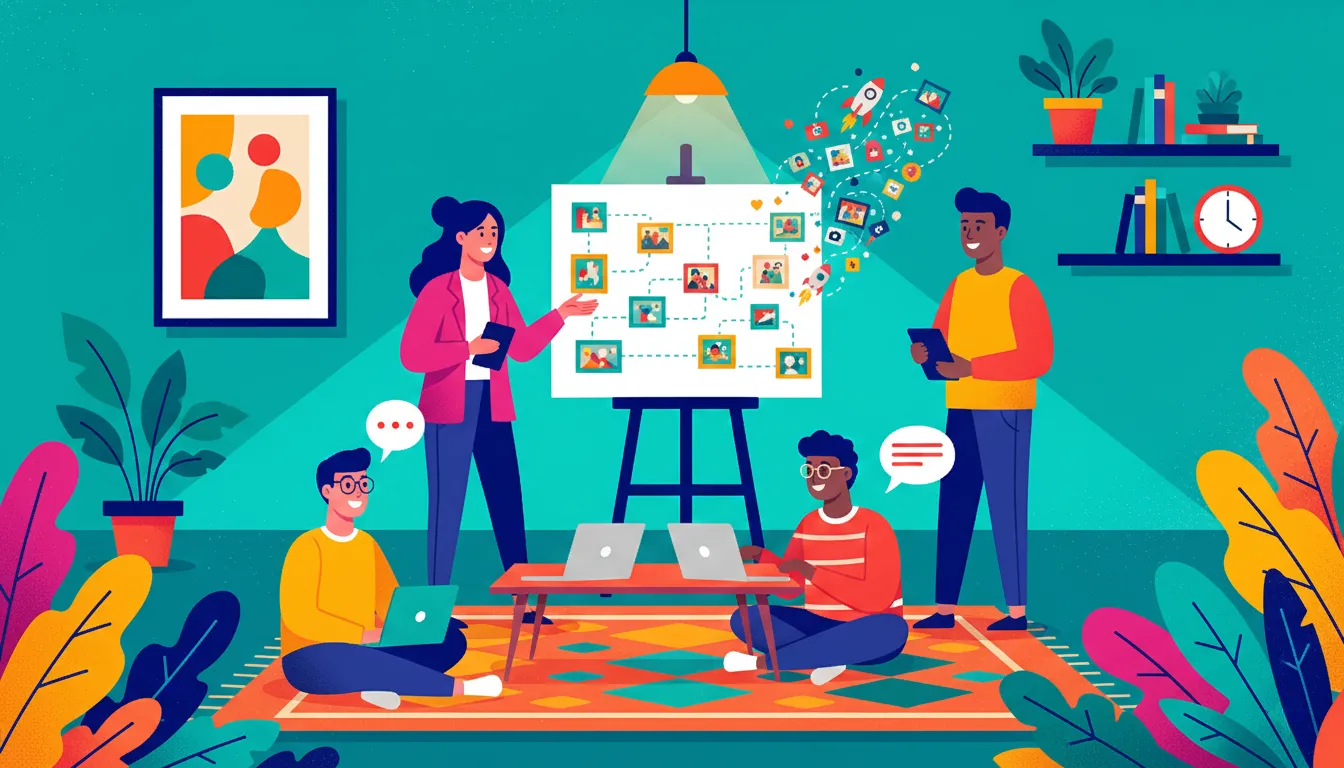
We're wired for stories. From bedtime tales to Netflix binges, narratives shape how we process information and make decisions. The question is no longer whether to use visual storytelling in your marketing—it's how to do it well.
What is visual storytelling?
Visual storytelling means using descriptive imagery and visuals to communicate your brand's message. It combines text, imagery, video, and audio to create experiences that stick. For digital formats, this often includes interactions and animations as well. Done right, it engages audiences, making them active participants who will remember your message and (in an ideal scenario) act on it.
Stories work because brains prefer them
Stories work because our brains prefer them. In 1944, researchers Heider and Simmel conducted an experiment where they showed people an animation of geometric shapes moving with no other dialogue or narrative structure.
Viewers invented entire narratives. They described characters with emotions, motivations, and conflicts. A recent study from 2024 even suggests that the emotional response may be stronger in 3D and interactive environments. It appears our brains crave cause-and-effect connections. We turn abstract patterns into stories whether we mean to or not.
That instinct is your advantage. When audiences emotionally connect with your story, they are more likely to stay engaged, remember, and take action.
Why visuals beat text alone
Studies have found that the processing of images by your brain can happen in as fast as 13 milliseconds. For reference: that’s faster than most AI systems’ text processing per word or token!
The pictorial superiority effect shows that images benefit from dual coding. That means our brain processes photos both visually and verbally, creating two memory traces instead of one. This makes it easier to remember and feel connected to a story.
Text still matters as it provides structure and specificity. But images, video, and animation do the heavy lifting for comprehension and recall.
How to make your digital content instantly more visual
Visual storytelling is more than adding images to text. It's using visual elements as the primary vehicle for your message. There are several ways you can make stories more visual:
Photography & video
Photography and video build trust faster than any other medium. Use it for testimonials, behind-the-scenes content, and product demonstrations. The catch? Stock material screams "generic". If your budget allows it, invest in original photography that feels genuine and authentic.
Illustration
Illustrations are perfect for abstract ideas or when photography would be too literal. They provide complete control over style and mood.
Data visualization
Charts, graphs, and infographics transform complex data into a narrative and can also be referred to as data storytelling. Don’t dump data on your reader all at once. Instead, reveal data points progressively to make the experience more meaningful.
Typography
Text can be visual too. Variable font weights, strategic sizing, and progressive reveals all give character to a piece of text. Alternatively, even small changes can optimize the reading experience. That bolded keyword isn't just emphasized, it's a visual anchor that guides scanning patterns.
Animation
Movement demands attention. Use it cleverly for micro-interactions, progressive reveals, or to guide attention. The only rule? Purposeful motion only. Every animation should have a function.
Color
Colors trigger emotions. Blue conveys comfort and relaxation. Red signals passion, but also anger. Wrong color choices can repel readers, whereas the right ones amplify your message.
Creating visual stories that actually get read
Users form first impressions in 50 milliseconds. Your visual story either earns the next second or loses it forever. Here are some key tips to keep in mind when designing your story:
Visual flow
Western audiences read left to right, top to bottom. Such reading patterns can be leveraged. Place your hook top-left, your payoff bottom-right. Use arrows, lines, and animations to guide the eye.
Contrast creates hierarchy
Differences draw attention. Make important elements impossible to miss by creating contrast between size, color, and weight.
White space is necessary
It's breathing room that prevents cognitive overload. Apple is a master at this. Every product release page screams "premium" without words. Ensure your layout does not become too cramped, especially on smaller screens.
Visual metaphors
Visualize when you can—it’s the classic “show, don’t tell” principle. Instead of writing about "growth," show a plant sprouting. Instead of "connection," show interlocking puzzle pieces. Metaphors make abstract concepts easy to understand at a glance.
How to apply this in your marketing
Start with a storyboard
Sketch your narrative flow before creating any visuals. You don’t need to be a designer to do this. Boxes and stick figures work just fine. What's the opening visual? Where should the eye move to? This will save you hours of revision.
Think in scenes, not pages
Each visual section should be a scene in your larger narrative. What happened before? What comes next? This mindset creates flow instead of disconnected assets.
Create visual anchors
A color, shape, or character that appears regularly creates continuity. Repeat key visual elements throughout your story. It's the visual equivalent of a musical motif that can ensure messages are better understood.
Test with real humans
Show someone your visual story without explanation. Where do they look first? What do they remember? What confuses them? Their fresh eyes catch what yours miss, providing input for improvement.
Four visual storytelling examples worth studying
1. Tales from the deep blue
The "Tales from the deep blue" publication proves educational content doesn't have to be boring. It follows the journalistic visual storytelling playbook similar to styles like National Geographic and The New York Times. Deep-sea facts transform into a narrative journey where information becomes digestible and fun.
2. Toxic self-talk
Bold typography, custom illustrations, and scrolling effects are combined to present a visual journey through the internal monologue. With careful texts and visual style, this story invokes empathy and resonates with the reader. The visuals aren't just decorating the message, they amplify its emotional weight, which serves it well given the seriousness of the topic. Check out the full story at toxicmonologue.com.
3. Light in the Darkness
Studio K95's horror film analysis includes a genius touch: a good/evil toggle that changes images on hover. Readers literally switch between perspectives, jumping between sides of a story with their mouse. It demonstrates how interactivity can reinforce your message by letting users control the perspective.
4. Wine Animals
Wine consumption statistics could be a boring report. Instead, research and data visualization meet scrolling narrative in The Pudding’s “Wine Animals”. Animal metaphors and progressive reveals on scroll turn numbers into a story. Perfect example of how scrollytelling makes complex information digestible without dumbing it down.
Can’t get enough? Check out more visual storytelling examples.
Measuring engagement, not page views
Traditional marketing metrics like page views and traffic volume were built for a different era. They tell you how many people arrived, but not whether they stayed, engaged, or cared. Visual storytelling demands a different approach to analytics, because the goal isn't just clicks, but preferably immersion and engagement.
Here's what you want to pay attention to:
- Scroll depth over page views: Visual stories should hit a minimum of 60% scroll depth. Below 40% signals pacing problems.
- Engaged time over raw traffic: Long-form visual holds attention for 3+ minutes on average, compared to 60-90 seconds for regular articles. Aiming for an average above 2 minutes would be a good starting point.
- Interaction rates over passive scrolling: Track active clicks with an analytics tool or heatmaps. These micro-actions signal active engagement.
- Action completion over vanity metrics: Shares, CTA clicks, and conversions matter more than impressions. Look at interaction rates to find the interaction to visitor ratio.
Watch for qualitative signals too: unsolicited feedback, shares with commentary, screenshots on social. Such feedback may indicate you’ve created something memorable.
Tools to use for visual storytelling
You don't need a design degree to tell visual stories. Here's your starter toolkit:
For graphics: Canva or Figma. They have templates, but don't rely on them. Use them as starting points, then customize.
For data visualisation: Datawrapper, Flourish, or Tableau to quickly turn spreadsheets into stories.
For illustration: Go the AI route with Napkin or use tools like Undraw for customizable vector illustrations. If it is within your budget, hire freelance illustrators on Dribbble or Behance.
For photo editing: VSCO or Lightroom for editing. Unsplash or Pexels for high-quality stock (but use sparingly). Don’t have the resources to curate your own photo collection? Try your hand at generating realistic images with Midjourney.
For video generation: VEED for a fast, browser-based AI video editor. Access a variety of AI video models like Veo and Kling to generate and compare different video styles in one place.
For animation: After Effects for complex motion, Lottie for web-ready animations, or Jitter to create your own from templates.
For interactive stories: Platforms like Maglr, when you're ready to level up with scrollytelling and tie it all together in a reader-controlled narrative.
Common pitfalls (and how to avoid them)
The template trap
A good story is original. Many organizations fall into the trap of using templates. While they’re convenient, they’re often not original. If you do decide to use templates, ensure to use them as a base and adjust accordingly.
The accessibility oversight
Not everyone views or reads the same way. Add alt text, ensure sufficient contrast, and never convey critical information through color alone to improve inclusion.
The cognitive overload
If too many visual elements compete for attention, readers will experience cognitive overload and have no idea where to look. That can negatively affect engagement. Use the squint test—squint at your design. If you can't identify a clear focal point immediately, simplify.
Get started with visual storytelling
Visual storytelling is how humans prefer to consume information. Whether you're explaining complex products, sharing company culture, or driving conversions, visuals carry your message faster and further than text alone. The tools exist. The techniques are proven. There’s no excuse for letting audiences wade through walls of text if you could give them engaging visual stories they'll actually remember.